Behavioral Problem Solving
Wild Welfare US supports and encourages using a Behavioral Management approach to caring for captive animals. An essential part of this is the Problem Solving Process.
It’s inevitable that problems, challenges, and unwanted situations will occur when animals are in captivity. These perceived ‘problems’ may not be a problem at all if animals are behaving consistent with their behavioral biology and natural history, yet even so there may be situations that give us concern for animal or human safety, potential enclosure integrity compromise, or conditions leading to diminished welfare – any of these situations might be represented as the ‘problem’. Deepening our understanding of what animals need to thrive and feel safe, must include a process by which we can evaluate and resolve any presenting concern or problem – thus enabling any facility to better protect and promote animal welfare and human safety while achieving its mission.
This Problem Solving Process was originally developed by Active Environments, Inc. and has been used, taught and adapted by Wild Welfare staff who for decades have worked alongside Active Environments. To learn more about the process, see and read the book Animal Training, Enrichment and Problem Solving, written by Wild Welfare US’ Executive Director, Margaret Whittaker, her long-time colleagues Gail Laule (Active Environments) and Valerie Hare (Shape of Enrichment).
The Problem Solving Process
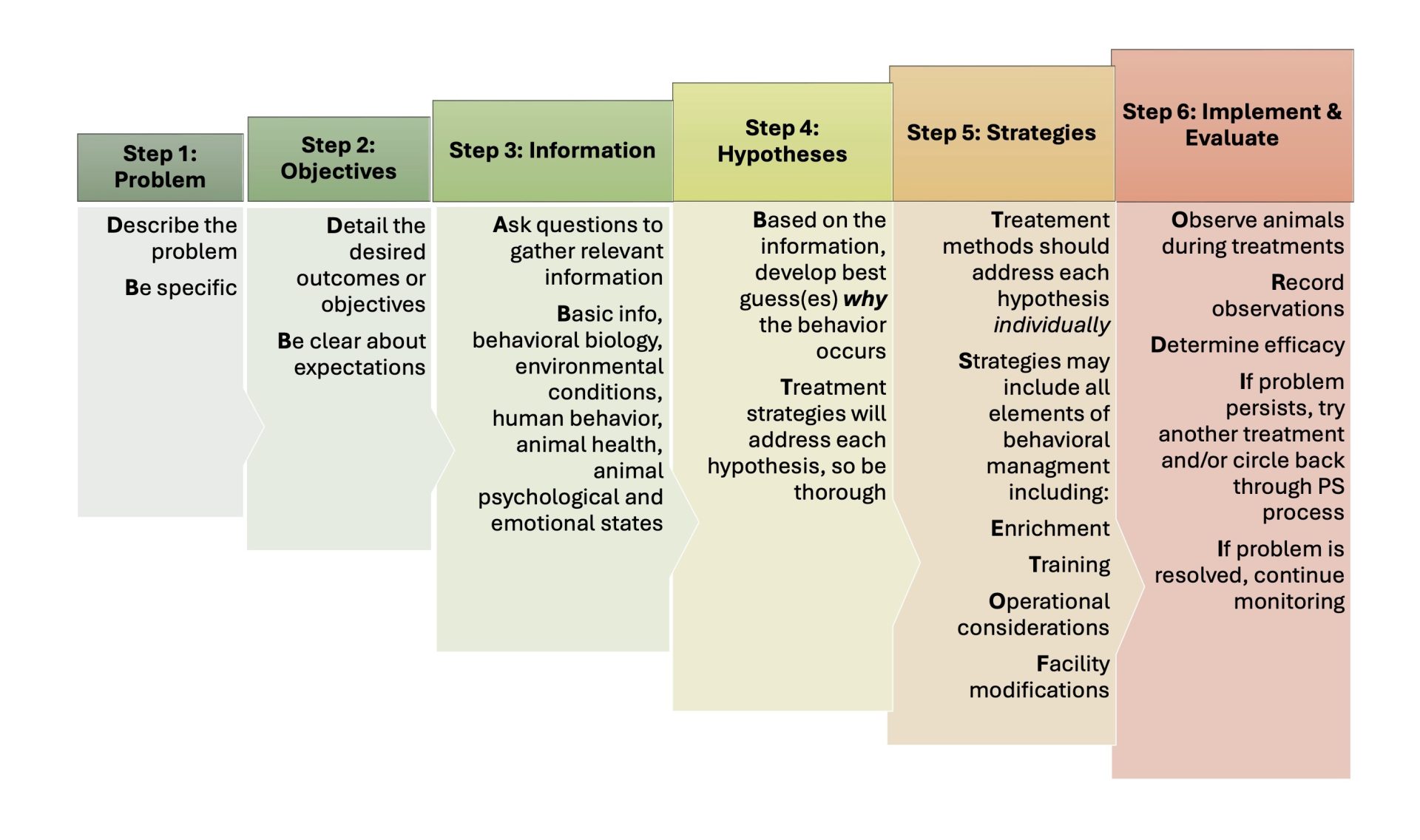
This process consists of the following, easy-to-follow steps which are illustrated below. An experienced facilitator will help ensure that the process is appropriately followed, all the relevant information is included, and the proposed strategies to address the problem are suitable for the animals, people, and facility or institution, and this is always carried out through the lens of optimal animal welfare practice. For more information on the problem solving process and exercise, please contact Wild Welfare US.