ENRICHMENT
What is Enrichment and Why is it Important?

Enrichment, inclusive of environmental and behavioral enrichment, is a dynamic process for enhancing animal environments within the context of the inhabitants’ behavioral biology and natural history. Enrichment should be dynamic, responsive, offer varied choices, promote engagement in species-appropriate behaviors thus enhancing an individual’s welfare. Enrichment includes species and individually appropriate challenges, opportunities, and stimulation. Goal-oriented, purposeful enrichment that encompasses strategies spanning all enrichment categories (physical environment, cognitive, social, sensory, and feeding) will yield the best welfare outcomes. Enrichment does not only include ‘things’ given to an animal but involves the entire environment including operations and physical characteristics.
What Should Enriched Environments Do?
- Promote feelings of comfort and security by providing safe zones
- Encourage physical activity resulting in excellent physical fitness
- Facilitate socialization as appropriate for the species
- Provide opportunities for problem solving through cognitive and behavioral challenges
Enrichment Is Not a Substitute
Enrichment is fundamental to positive welfare but cannot be a substitute for inappropriate enclosure designs, poor or unvaried feeding regime, inadequate healthcare, or other management activities that compromise animal welfare. Enrichment should not be considered as something ‘extra’ done when there’s extra time, but instead is part of the daily provision of care for captive animals.
Key Points of Enrichment

Change
Something in the environment changes which empowers animals to learn, think, and respond to fresh, dynamic and engaging environments. Changes should span all enrichment categories (physical environment, social, sensory, cognitive, and feeding/foraging) and rotated to avoid habituation.

Opportunity
Change provides opportunity – Animals’ behaviors are how they express their feelings about the environment as a whole. The opportunity to exercise agency and behave in response to an engaging and enriched environment is crucial for positive welfare.
Choice
Enrichment provides choices – choices include environmental parameters (e.g., thermoregulation options, resting and comfort seeking), promote rewarding natural behaviors (e.g., foraging/food acquisition, self-care, natural locomotion patterns), and encourage exploration and interaction within the environment – thus animals feel a sense of control and autonomy.
Enrichment Program Development
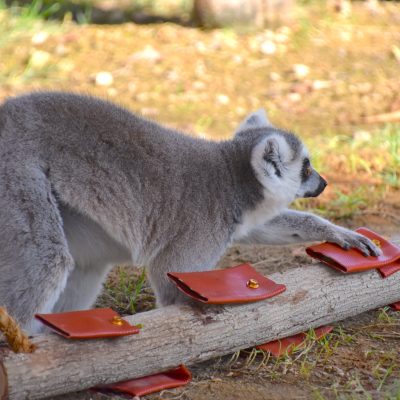
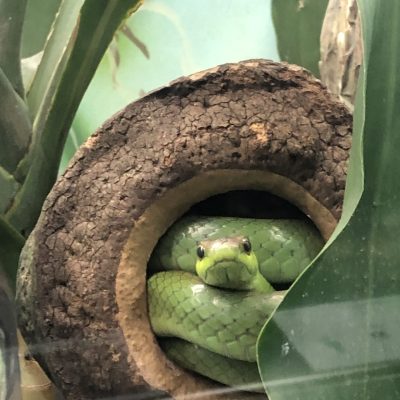

A comprehensive enrichment program is behavior-based, goal-directed and designed for the individual animals and species, and should be purposeful to include clear objectives, account for individual and species needs, and yield and appropriate interaction between the animals and their environments. Comprehensive enrichment programs have requisite elements to assure goals are met in a safe, interactive environment that enhances animal welfare and creates optimal behavioral, mental and physical health, and physical fitness.
Essential Enrichment Program Elements should create a circular system of checks and balances to ensure appropriate goals are developed and met within a safe environment, and that documentation and regular reviews are included. There are a number of different approaches to this; we use the following enrichment planning model adapted from Shape of Enrichment.
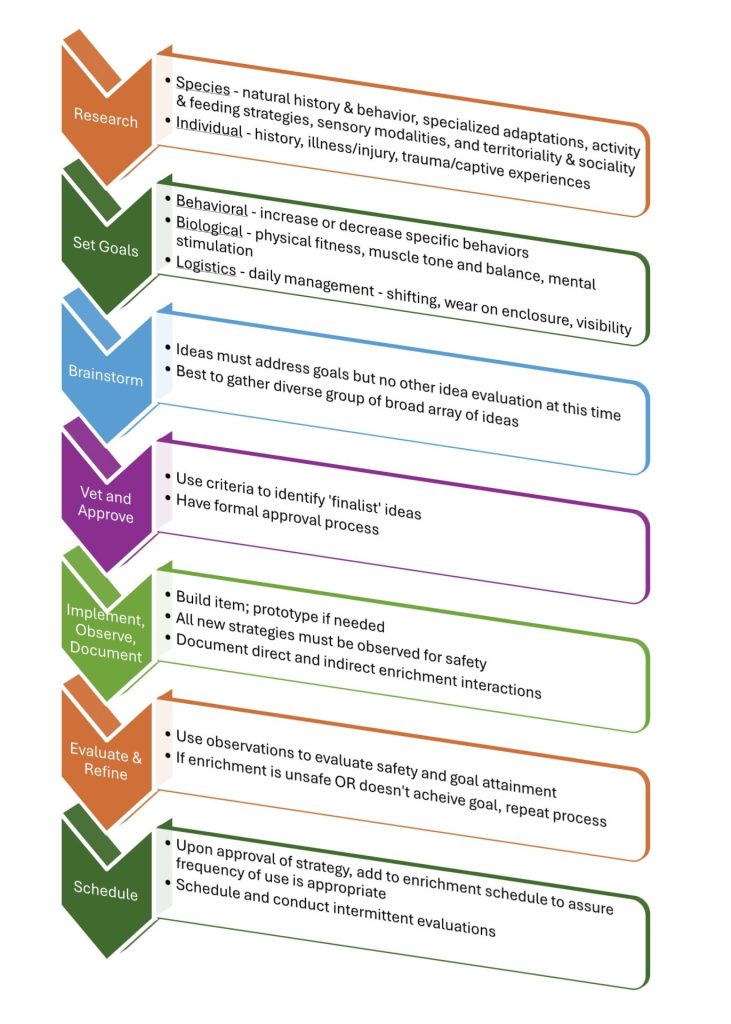
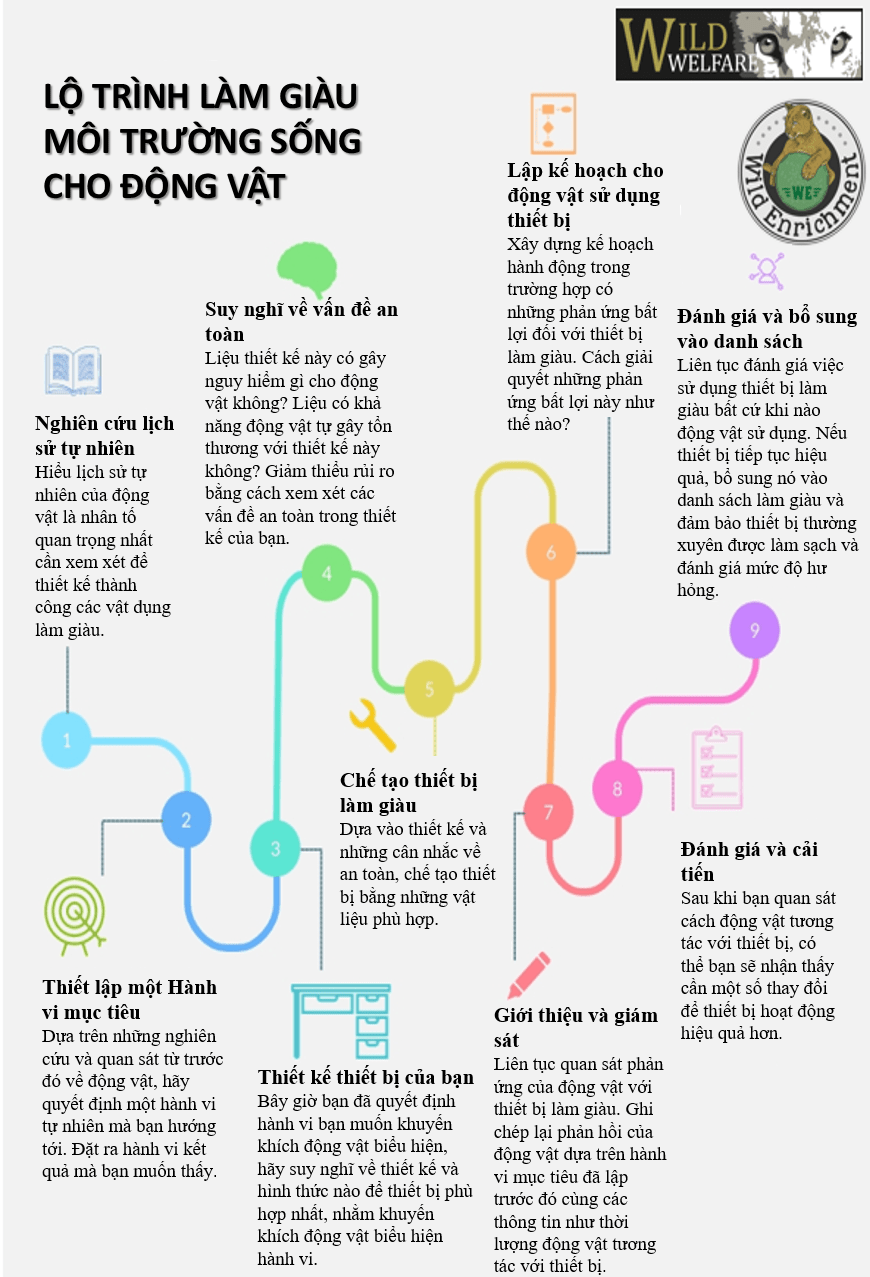
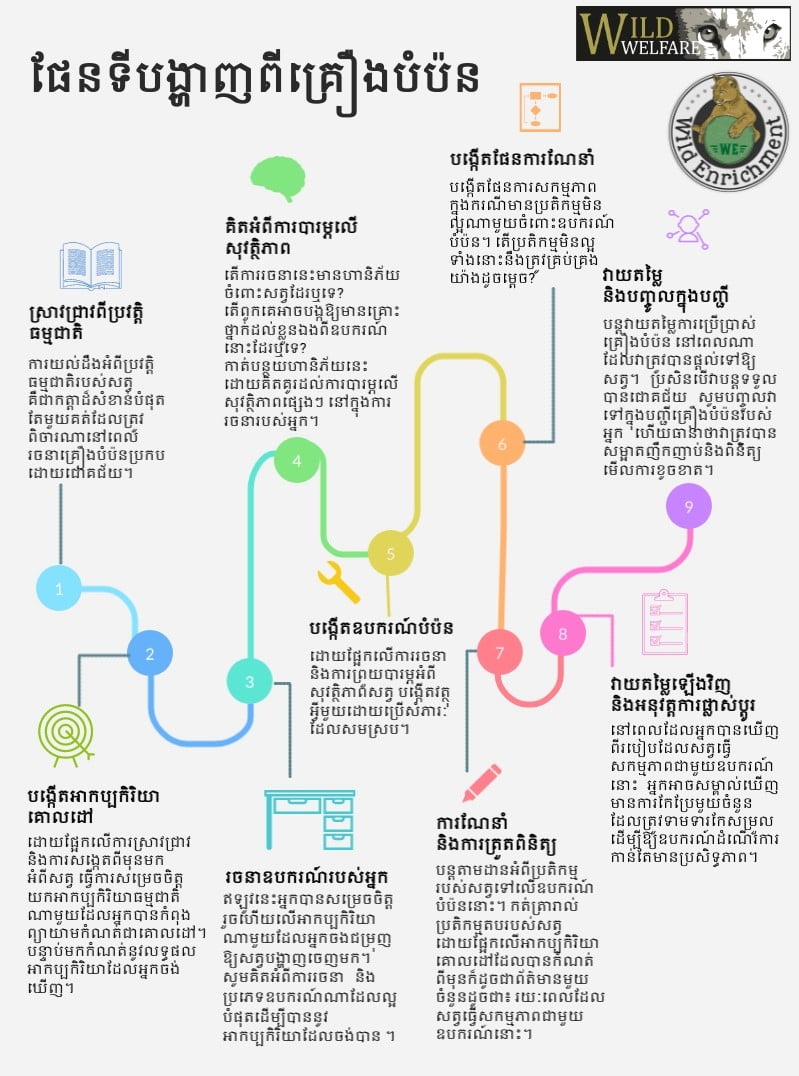
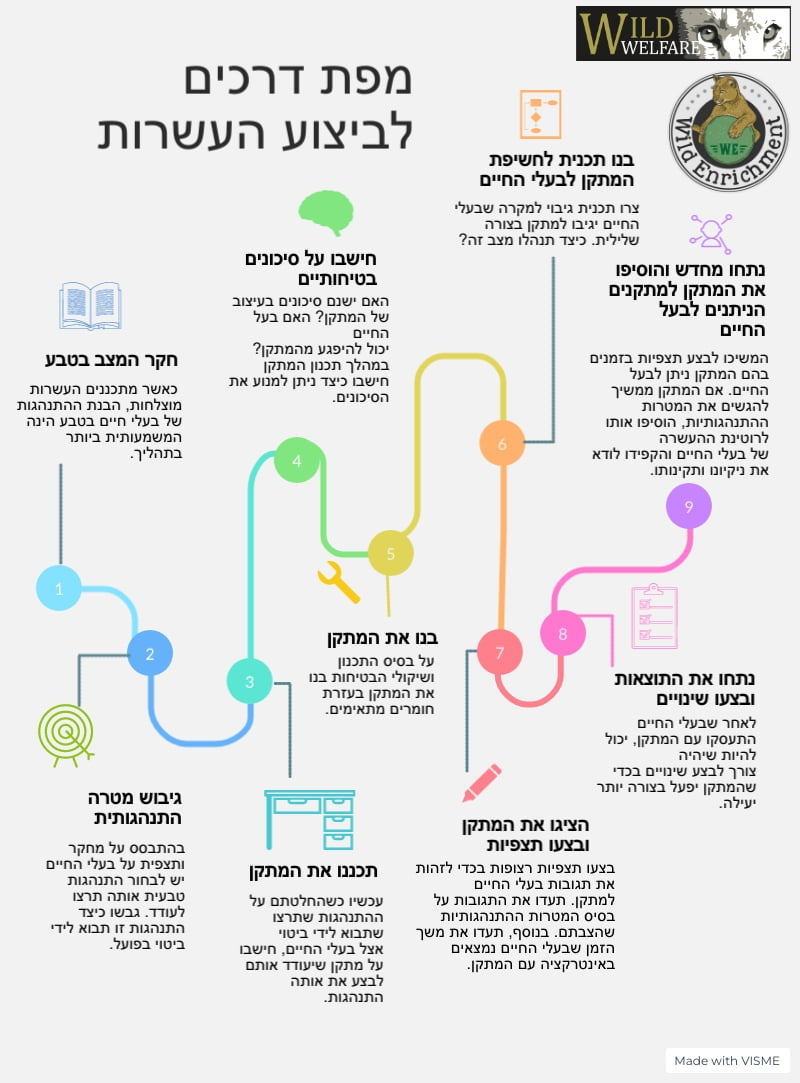
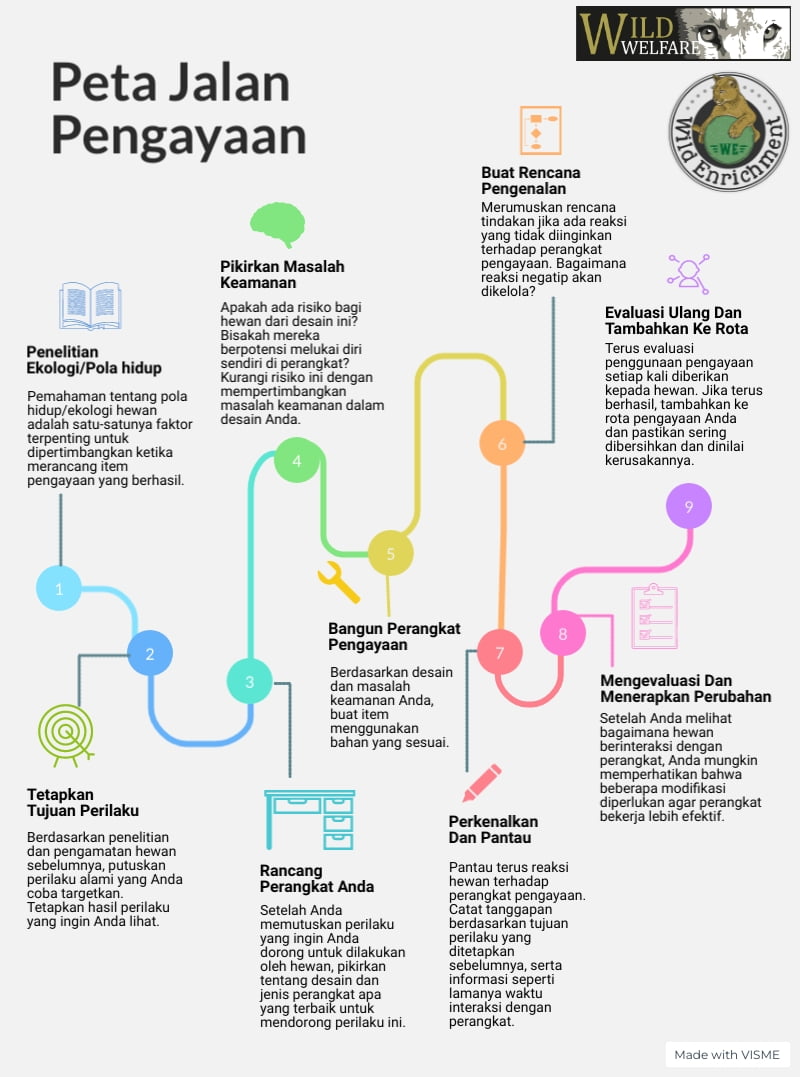
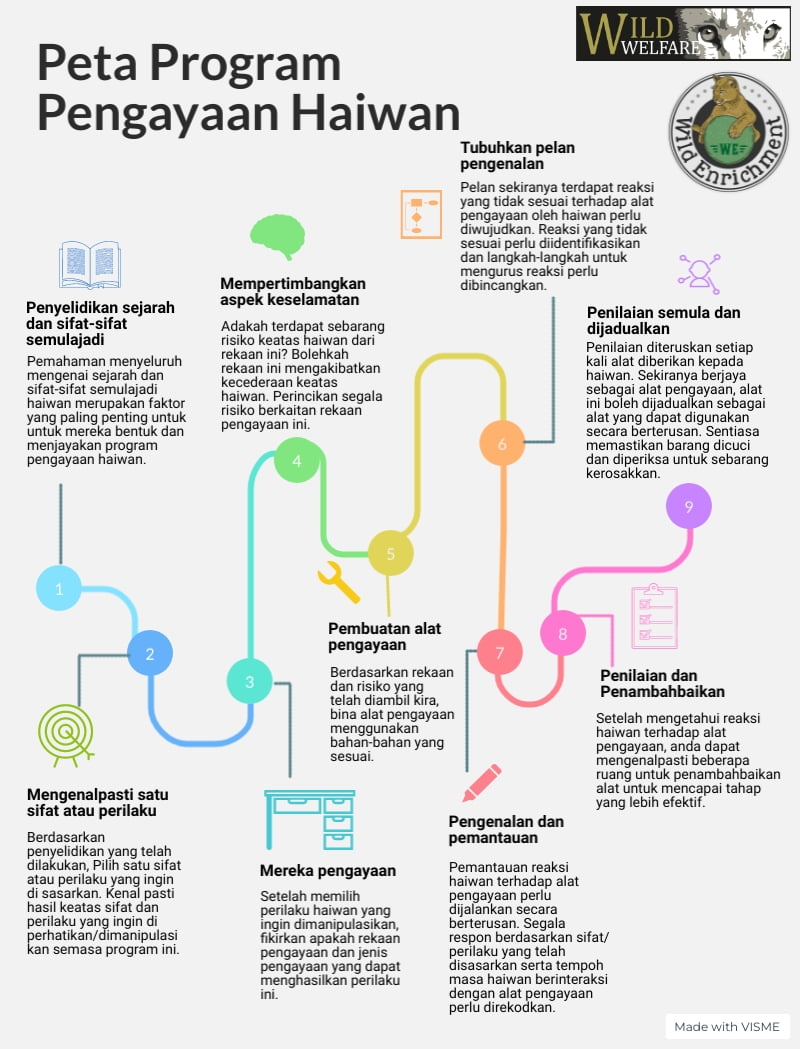
Enrichment Roadmap
ENRICHMENT ROAD MAP – another option for enrichment planning
The Wild Welfare enrichment road map, created in conjunction with Wild Enrichment, guides you with another approach to enrichment programming from planning through to assessment. It is currently available in the following languages:




5 Categories of Enrichment
Enrichment can be divided into different categories. This is helpful when organizing the best way to provision different types of enrichment to meet different types of goals. At Wild Welfare US, we use the 5 Categories of Enrichment developed by our friends at Shape of Enrichment.

The 5 Categories are Physical Environment, Sensory experiences, Social setting, Cognitive engagement, and Feeding/Foraging. Some categories better address goals than others so when planning, consider all the categories that may be best. Balance the types of enrichment used against an individual’s preferences and the species’ requirements to achieve objectives and keep enrichment strategies fresh and engaging for the animals. Please note the 5 Categories are not mutually exclusive, meaning an enrichment strategy may fall into more than one category.
Physical Environment
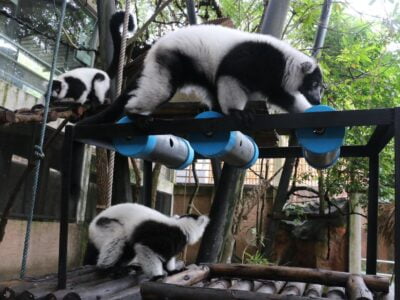 Pathways for climbing and traveling; change regularly to keep interesting
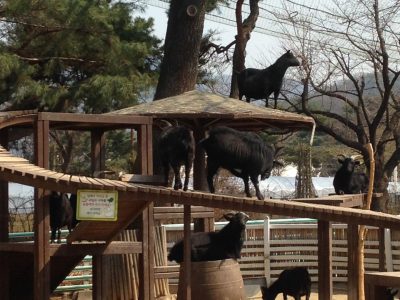 Multiple levels expand useable space, promote appropriate behaviors, and provides a great view
 Substrate piles are used differently than substrate. Let the animal spread it around!
Sensory Enrichment
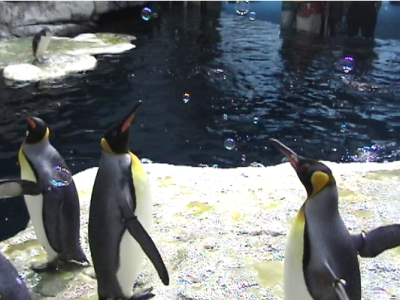 Bubbles are a visual sensory enrichment
 Wind chimes that are activated by the animal are best
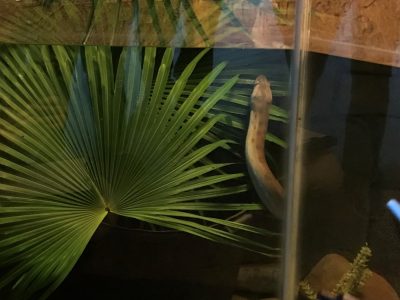 Palm fronds provide the anaconda with tactile and visual enrichment, and provides cover
Social Enrichment
 Chimpanzees work together gathering foods from an artificial termite mound
 Mixed Species
 This feeder brings these two waterbuck closer together without competition
Cognitive Enrichment
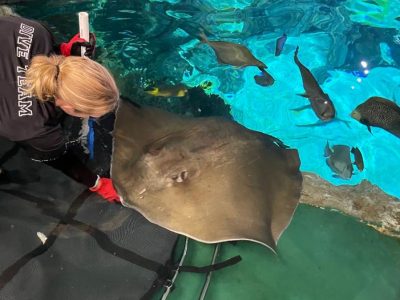 PRT promotes active mental engagement to learn a new behavior, like this ray learning to swim onto a stretcher
  Puzzle feeders come in many forms; they should present challenges appropriate to the individual and species. And it's best if the challenge level can be increased with the animal's skill.
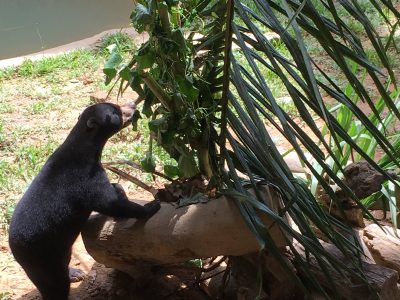 Novel experiences, such as the large palm fronds, engage the animal cognitively
 Feeding Enrichment
 A feeder can have multiple goals - this one offers food at different levels in the water column, increases feeding time, and encourages natural feeding behaviors
 Turtle feeders distribute food to minimize competition and promote problem solving when acquiring food from different devices.
 PVC can easily be made into different types of puzzle feeders
Take a look at Hose2Habitat’s website for ideas on how to use old hoses to address all 5 Categories of Enrichment
Enrichment Safety
An enriched environment offers immense benefits to animals but also presents some risks compared to a sterile, non-enriched environment. Therefore attention to safety is crucial!!!

Conduct risk assessment and reduction activities. Ask yourself what could happen and what is likely to happen.
When considering potential risks, ask yourself the following:
- Can the animal(s) harm themselves? Other animals? Staff? Visitors? The facility/enclosure?
- Can the animal(s) use the enrichment to escape?
- Will the enrichment block caregiver access to any parts of the enclosure?
We recommend using an enrichment approval process for best practice of enrichment safety. Click here for a sample approval form.
Some helpful hints for enrichment safety:
- Always observe animals when a new enrichment strategy is used; document observations.
- Routinely check enrichment for wear and tear, sharp edges, other hazards.
- Learn how to properly secure rope with knots that last and by using splicing techniques.
- Always remove frayed rope immediately upon seeing it – don’t wait; disaster could happen
NOTE THE IMAGE: The large loop of rope where the box hangs poses entrapment risk for the orangutan’s head or neck; the height of the loop increases the risks!
Safety considerations and questions to ask yourself – Is there a risk of:
- Entrapment or entanglement – either in attachment mechanism or device itself? Think about body parts, if there are ropes or bungees that can wrap around body parts.
- How is it attached? Are there loops for entrapment?
- Are there holes in the device that increase risks of a body part or entire body getting caught?
- Physical restraint – Ropes can wrap around an animal’s body or body part and trap them. Larger diameter rope is less likely to wrap, and covering ropes with more rigid material reduces wrapping risk.
- Injury such as cuts or wounds from sharp edges. If item breaks, will there be sharp edges?
- Ingestion risk – no wet foods in fabric or soft containers that will take on smell of food and may be mistaken as food. Is item compressible/soft and therefore can change shape and possibly be consumed or lodged in animal’s mouth.
- Safe for everyone in enclosure? Multi-species, age and size ranges, how individuals may use item?
- Provide sufficient enrichment for everyone in enclosure; if you have 5 animals, provide 6 or more items to reduce competition.
NOTE THE IMAGE: The openings in the firehose weave are large enough for the hornbill’s beak and head to get stuck. The height this is hung poses further risks if the bird jumped to get food out of the openings, became stuck, and was left hanging unable to free himself.


Some risk reduction solutions for entrapment in ropes:
- Use only natural fiber rope including manilla or sisal.
- Learn to properly and safely secure ropes with splicing and knot tying techniques.
- ALWAYS cut frayed rope as this can easily entangle an animal.
- Reduce chance rope entrapment around body or body part – Cover rope with more rigid material such as PVC, fire hose, garden hose OR use large diameter rope to reduce wrap risk.
- No heavy weights on end of long rope; these increase entrapment by a wrap the animal cannot undo due to weight on end of rope.
NOTE THE IMAGE: The frayed ropes can easily entangled an animal resulting in injury or death.
Some risk reduction solutions for entrapment in device with holes (e.g. puzzle feeder):
- Hole size must be either very large for easy removal of body part or or very small to prevent insertion.
- Diameter of device – e.g. tires – use very large tire to prevent entrapment OR cut tire so it’s a broken circle.
- Check items regularly for wear and tear – opening size and shape can change over time and with use.
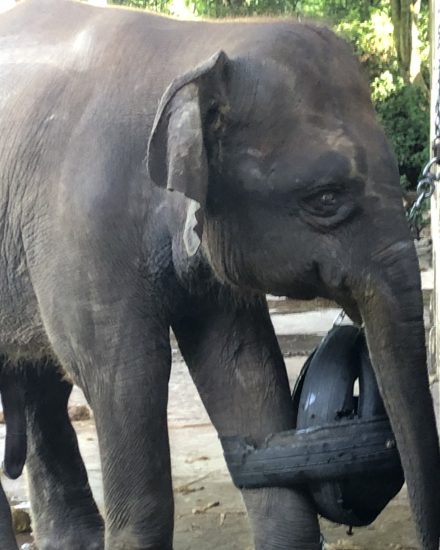
NOTE THE IMAGE: The young, playful elephant got his leg stuck in the tire toy because he compressed it thus creating openings large enough for his leg, and when the compression pressure was release, he was stuck.
Wild Welfare US offers consultation and advice to develop safe and effective enrichment for all animals; for more information CONTACT US.